(Slovenia)
Provocar situaciones ambiguas en momentos politicamente delicados (la crisi de la federación yugoslava y posteriormente la guerra entre sus miembros), además de utilizar nombres en alemán y una estética totalitaria, fue la estrategia comùn del NSK (Neue Slowenische Kunst, = Nuevo Arte Esloveno). Considerado hoy como uno de los hitos de la experimentación artística en Europa de los ùltimos veinte años, NSK empezó a funcionar en 1984 como unión de varios grupos radicales que compartían una visión provocadora y un estilo expresivo parecido a través de diferentes medios: mùsica (el grupo Laibach), artes visuales (Irwin), diseño gráfico (Novi Kolektivizem), teatro (Scipion Nasice) y filosofía (Departamento de filosofía pura y aplicada).
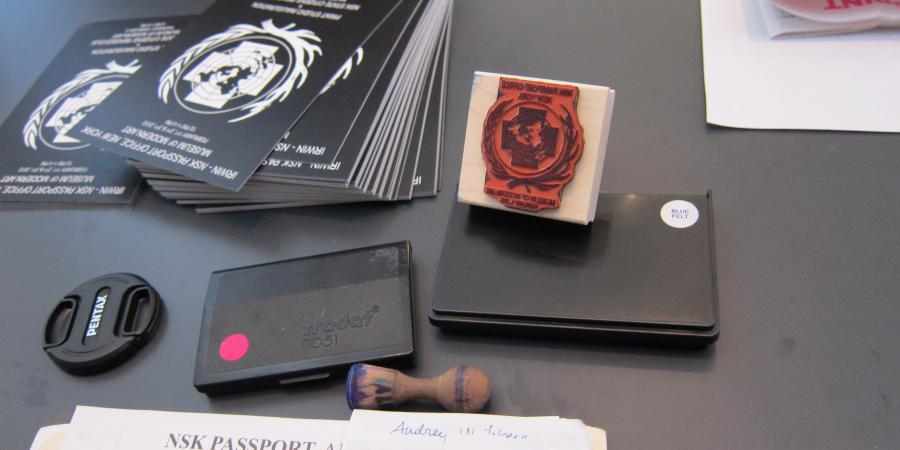
Los artistas del colectivo Irwin se pueden considerar los biógrafos visuales del NSK. Su trabajo, enmarcado en la tradición de los regímenes totalitarios, ponía en escena una reapropiación de símbolos suprematistas del Bloque de la Europa Oriental, construyendo su propia identidad como 'artistas de estado' fieles a una estricta disciplina colectiva. Abrieron consulados, diseñaron insignias y difundieron pasaportes del NSK, un "estado en el tiempo" que llevaba a los extremos las paradojas de la identidad estatal hasta a dejar entrever la cara oculta de las estructuras ideológicas existentes.
|
Introduction. Neue Slowenische Kunst and its beginning in 1984 (Laibach started in 1980, while Irwin and Scipion Nasice Theater in 1983). We started to work together in times of large civil society movements. Art and theory were trying to answer the question of what kind of state we were living in. We took art as a religion, each group within its own media. A brief survey on the various groups comprised within the label of NSK: Laibach, a music and art group which was meant to work as a mirror of the state. Scipion Nasice Theater: in those firts 4 years we went from the phase of illegality and anonimity to the phase where we were doing shows and performing for 2000 people. As a state theater we wanted to claim the end of theater, so the group eventually died. |
The Irwin collective. The Was Ist Kunst series on the ideology of art. We don't consider ourselves as political artists, but rather we focus on how art itself is always political in certain contexts. We work on icons and stick on just a few "motifs" (subjects). In our paintings we are not interested in endorsing the idea of the supposed artist's freedom of choice in the subject. |
|
The Black Square on Red Square guerrilla action (with the help of KGB). |
The Interpol exhibition, the art exhibition that divided the East and the West. |
|
The East Art Map book. |
More from the East Art Map project. For this project we did not consider ourselves as experts, but as who provides the conditions for a project to be realized. |