
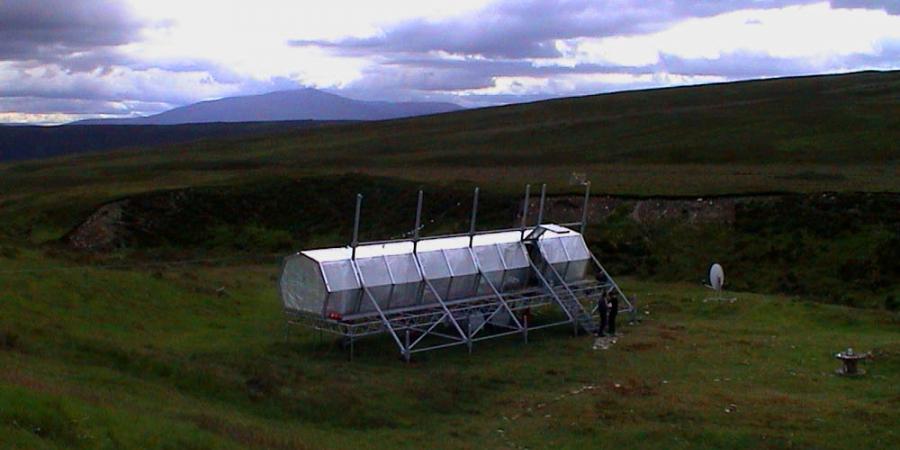
Marko Peljhan started Makrolab as an autonomous communications, research and living unit and space, capable of sustaining concentrated work of 4 people in isolation/insulation conditions for up to 120 days. Conceived in 1994, the project was first realised during an art exhibition, documenta X in Kassel in 1997 and since then it evolved including work of many people from many different disciplines. Makrolab has a projected life span of 10 years and the project will end in 2007, when a new architecture will be placed in the Antarctic as a permanent base.
In the framework of the proejct, robotic UAV operations are planned and the INFLUENCERS presentation will be focused on the corresponding Spectral System program with the title "Unmanned systems architecture in civil tactical media and reconnaisance applications - The Spectral System Program" that he is pursuing as part of the research agenda at the University of California in Santa Barbara, where he is currently holding a professorship
|
The doctrines of conversion of technology from the military to the |
Makrolab, a 10 years project: seeing society through sensors, mapping telecommunications, migration patterns, climate changes. System 77 Civil Counter Reconaissance (s-77ccr): distributed sensors foor robotic data collecting. |
|
The social and political premises of s-77ccr. The art field: theofficial presentation / exhibition in Vienna (2004). The test flightplans for Tarifa during the Fadaiat meeting in 2005. |
The international discussion about flying a civil Unmanned AerialVehicles and the aims of Project Atol: the conversion of technologiesand spreading the knowledge. |
|
More questions and answers. Our aims: openness and empowerment of thecivil society. More details on the test in Tarifa (Andalucía, Spain),planned for July 2005. |
Questions and answers. More on the use and licensing of the informationcollected by s77-ccr and on the motivation behind the Tarifaexperiment. Technical facts and production information about thes77-ccr. |