
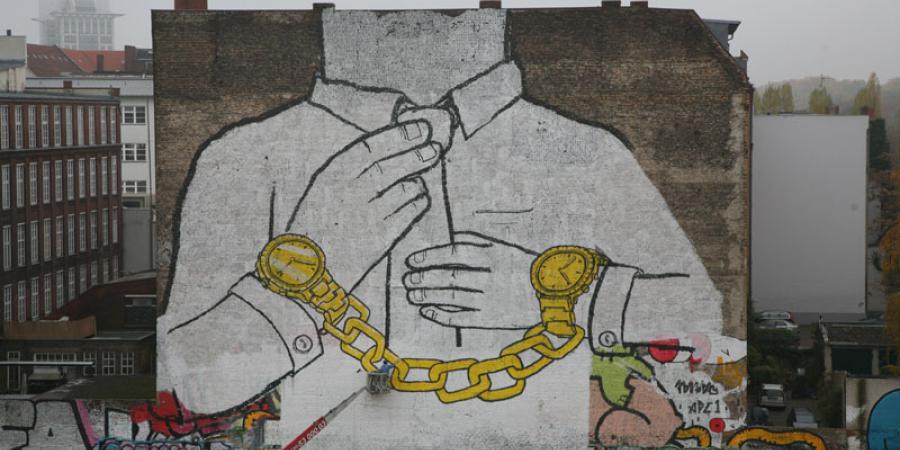
BLU

http://www.blublu.org

At the beginning street art was considered an illegal practice close to pure and simple vandalism, while now it is largely acknowledged as a relevant creative, artistic and social phenomenon. BLU, among others, contributed to shape this new creative practice and define its distinguishing marks: reclaiming free public space, breaking daily routines through surprise and finally sending out messages to its audience (and not simply embellishing city walls).

The huge figures and the elaborated scenes drawn by BLU appear in anonymous or emblematic places, inserting the sense of adventure within the urban routine, blending personal invention with relevant public issues, adopting a strategy based on high visibility with a strict defense of anonymity. BLU's drawings are spread all over the world, some of them watched over carefully by the inhabitants of the neighborhood, others exposed to the uncertainty of their natural environment. 

Even though BLU's first aim is not getting media visibility, he was nonetheless one of the authors of a resounding action that took place right before Christmas 2007: the "symbolic attack" against the big wall that was built by the Israeli government to isolate the Palestinian territories.

Videos & Sounds

El tiburón (=The shark).
7 days on the top of the Carmel hill, a working class neighborhood in Barcelona. Under heavy rain, sun and wind and surrounded by curious residents and passers-by.

Introduction.
The example of Barcelona and the transformations that took place in the last 10 years in the words of a group of street artists based in the city. The privatization of public space. The local ordinance "on civic behaviour", the boom of so called "vandalism" (tagging) and the ambiguities of public authorities.
[Original version in Spanish]

Another example: Milan (Italy). Clean-up operations and real estate speculation. Painting the Cox18 historical squat and the Contemporary Art Pavillion at the same time. Acts of vandalism by political parties.
[Original version in Spanish]

The example of Berlin and the perception of the value of walls. A mural painting in november 2008 and another one in collaboration with JR. The current contradiction of street art: between repression and creating economical value. About painting on the street and losing control and authority over it. [Original version in Spanish]

The example of Managua (Nicaragua). The mural painting in the Avenida Bolívar. The example of Sao Paulo (Brasil), an ads-free city.
[Original version in Spanish] 

Some interesting aspects of the walls in Latin America. Animation plus graffiti = the short movie "Muto" (=Mute).
[Original version in Spanish]

A short film by Blu.
An ambiguous animation painted on public walls.

Made in Buenos Aires and in Baden (fantoche)

blublu.org/
blublu.org/sito/video/muto.htm

The example of Betlehem (Palestine / Israel).

Q&A.
How did you make "Muto" and how long did it take?
How do you economically sustain your work?
Could you talk about your work in Mexico?
Are you asked to paint on walls, are your expenses covered?
Should public authorities reserve free space for street painting?
Do you make sketches before painting?

The Influencers newsletter